Overview
The mode of discovering job opportunities by job seekers is going through some transformations, which is rather speaking. Just as voice assistants have made their way to our day-to-day lives, they have also infiltrated job boards. Now, through smartphones, smart speakers, and even the in-cab infotainment systems, drivers and recruiters can access the listings and post vacancies with their voices. This article will cover the discussion about the robust transformations in recruiting through voice search trucking jobs, the importance of an Alexa Siri job board in trucking, and how hands-free driver search can boost productivity on both sides of the hiring game.
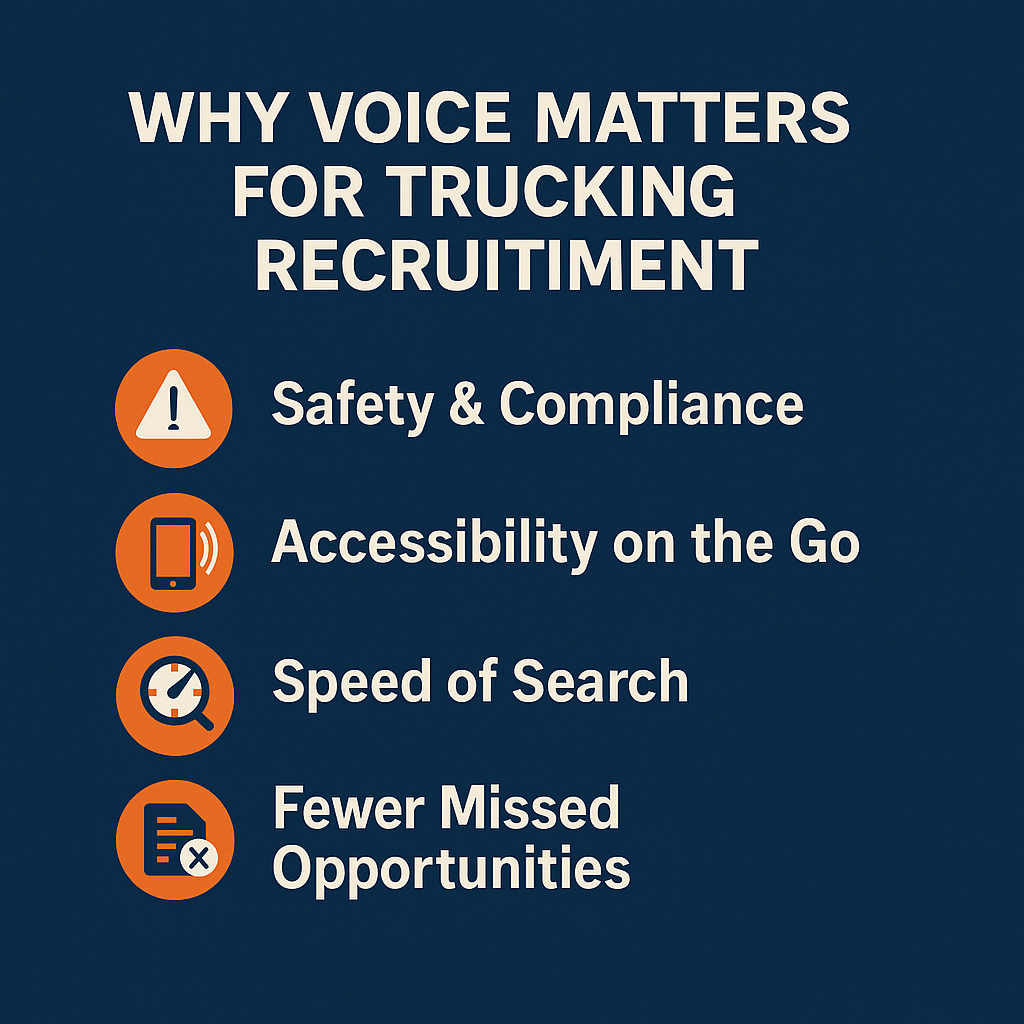
Why Voice Matters for Trucking Recruitment
Long-haul truckers often find themselves driving in rural areas for hours with no internet connection. Instead of running Siri or Alexa to search truck openings, they would need to first pull over and go through mobile apps and websites. The same thing goes for recruiters with responsibilities regarding safety compliance and routing logistics who can post or update listings on the go—no laptop necessary. As a result, they are linked up with qualified drivers faster, fewer job offers are left missed, and that thus, they have found a clearer way to fill driver shortages.
Main reasons for the importance of voice:
- Safety and Compliance: Only voice commands are what it takes to ensure a driver is not distracted by any of the possibles.
- Accessibility on the Go: The technology with hands-free operation is in cabs, trucks, and warehouses.
- Speed of Search: Voice queries can allow you to find openings within seconds, as compared to manual browsing which is of minutes.
How Alexa and Siri Integrate with Job Boards

Amazon’s Alexa and Apple’s Siri have the third-party “skills” or shortcuts that connect voice commands to the backend APIs. For information on running trucking job sites, that means stating a skill that deals with command like “Find me Class A CDL openings within 50 miles”. The assistant does this, and it reads the top match for the driver, sends pack and instructions on texting or emailing, or
even prompts the driver to apply for jobs directly on the platform if the platform supports autofill.
The common path:
- Invocation: “Alexa, open Trucking Talent jobs.”
- Query: “Show voice search trucking jobs near me.”
- Response: Top 3 listings read aloud, with options to save or apply.
- Follow-up: “Apply to the second opening,” triggering an in-cab hands-free driver search and application process.
Note: While “Trucking Talent” is just one example of a platform exploring voice integrations, the principles outlined here apply to any forward-looking job board.
Key Features of a Voice-Enabled Job Board
Voice integration isn’t merely a gimmick—it can provide a significant boost over traditional job portals. The must-have features for the Alexa Siri job board are as follows:
- Natural-Language Understanding (NLU): Accurately interpret queries like “short-haul refrigerated openings.”
- Location Awareness: Use GPS for driving the results to the driver’s current region.
- Application Management: Let drivers save, apply, or get reminders without touching any screen.
- Permissions and Privacy: Make sure that the users will need to grant their location and contact details explicitly.
Comparison of Alexa and Siri Job Board Integrations

| Feature | Alexa Integration | Siri Integration |
| Invocation Phrase | “Alexa, open [Skill Name]” | “Hey Siri, show me [Shortcut Name]” |
| NLU Flexibility | Supports multi-turn dialogues (follow-up questions) | One-shot queries; follow-up via “Hey Siri” prefix |
| Platform Reach | Amazon Echo, Fire TV, mobile Alexa app | iPhone, iPad, Mac (Catalyst apps), CarPlay |
| Custom Notifications | Push notifications via Alexa app | Local notifications via iOS Shortcuts |
| Integration Complexity | Requires AWS Lambda, Alexa Skills Kit | Leverages iOS Shortcuts and SiriKit |
Benefits of Hands-Free Driver Search
The change from being screen to be voice allows a spectrum of advantages to drive, recruit and platform owners:
- Enhanced Safety
Speaking, in its very first step, avoids temptation, to go browsing when driving; so your DOT regulations, and company policies are in alignment. - Improved Accessibility
Drivers with limited dexterity or those who have a sight impairment can still navigate the job board effectively by voice alone. - Faster Hiring Cycles
Recruiters can quickly fill the job vacancies through the voice by the time they make a posting or urgent announce it, which will result in reducing the time between an opening and a filled seat. - More Engagement
Using the voice prompts, the platform can issue summaries of new openings daily or weekly which keep drivers engaged dropping them out of that task. - Data-Driven Insights
The platforms can obtain voice query logs and discover which skills, routes, or benefits are causing the most demand among drivers, leading to refined marketing and training programs — and even helping you to hire truck drivers: https://truckingtalent.com/hire-truck-driver

Best Practices for Implementing Voice Search
If you are developing or upgrading a trucking job board with voice functionality, here are the tips to follow:
- Focus on Core Queries First
Start with covering the necessary phrases: “voice search trucking jobs,” “hands-free driver search,” and related high-traffic expressions. - Implement Clear Feedback Loops
When voice commands are misunderstood, give the users a fast correction route, “No, I meant find refrigerated truck openings.” - Offer Multi-Modal UI
Back the voice results with graphical confirmations in the app or web layout for those times when drivers are off-duty. - Keep Training Your NLU Models
Gather anonymized voice query data (with consent) to make sure you understand and acknowledge industry-specific jargon and acronyms. - Privacy and Security
Stick to the rules of GDPR, CCPA, and others, first ask explicitly the user’s permission for utilizing any personal data or location access.
Voice-Search Job Board Implementation Checklist
| Step | Recommendation |
| Define Use Cases | List top 10 voice queries (e.g., “find local driver openings”) |
| Choose Platform | Decide between Alexa Skills Kit, SiriKit, or both |
| Build and Test Prototypes | Run pilots with small driver groups; iterate based on feedback |
| Integrate Notifications | Enable push/local notifications for job alerts |
| Monitor Performance | Track query success rates and application conversion via voice |
| Iterate and Enhance | Add FAQs, refine NLU, and expand to other voice assistants |
The Future of Voice-Enabled Hiring
Voice technology is growing rapidly. Here are some of the things to pay attention to:
- In-Cab Smart Hubs: Trucks are being built with voice assistant inside the dashboard, and this will make it easier even beyond the initial point of downtime for drivers to access job boards to.
- Conversational AI Advancements: As models get better at context retention, assistants will proactively suggest openings based on the driving patterns, seasons, and driver preferences.
- Cross-Platform Continuity: A search that has started on an Echo Dot in the house will be finished on a mobile and in an in-cabin system, that will be a seamless transition and will keep drivers connected.
- Integration with Training Systems: Voice assistants could recommend nearby CDL renewal courses or interactive safety quizzes, closing the skills gap as openings get filled.
Closing Remarks
Voice search is not a fad anymore, but rather it is getting faster to turn into a central approach for the connection drivers to employers. With the advent of voice search trucking jobs, an Alexa Siri job board, and the promotion of a hands-free driver search experience, the platforms can create a unique identity, improve safety, and speed up the hiring cycles. Whether you are the manager of one of the leading industry portals or you are just getting started exploring voice capabilities, the time to act is now: let the voice assistants do the hard work while you concentrate on putting qualified drivers in your open positions.